Quick Answer
White label vs. private label skincare: White label means you buy an existing, generic formula that multiple other brands can also buy and resell with minimal changes. Private label means you select from a manufacturer's proven formulations but customize the branding, packaging, labels, and product selection — so the line is recognizably yours even though the base formula isn't built from scratch. For most med spas, dermatology practices, plastic surgery offices, aestheticians, and skincare entrepreneurs, private label is the stronger long-term choice because it protects your brand identity, your margins, and your ability to differentiate.
If you're researching how to launch a skincare line, you've almost certainly run into two terms that sound similar but carry very different business implications: white label and private label. Confusing them is one of the most common — and most expensive — mistakes a first-time skincare brand can make. Choose the wrong model and you can end up selling the exact same bottle your competitor sells, eroding your margins on every reorder, and building no brand equity you actually own.
This guide breaks down the real difference between white label and private label skincare, what each model costs, how fast each launches, and which one is right for your med spa, practice, or skincare brand. By the end you'll know exactly which direction fits your audience, your budget, and your long-term goals.
White Label vs. Private Label Skincare: The Core Difference
The simplest way to understand the distinction is to ask one question: who else can sell the exact same product?
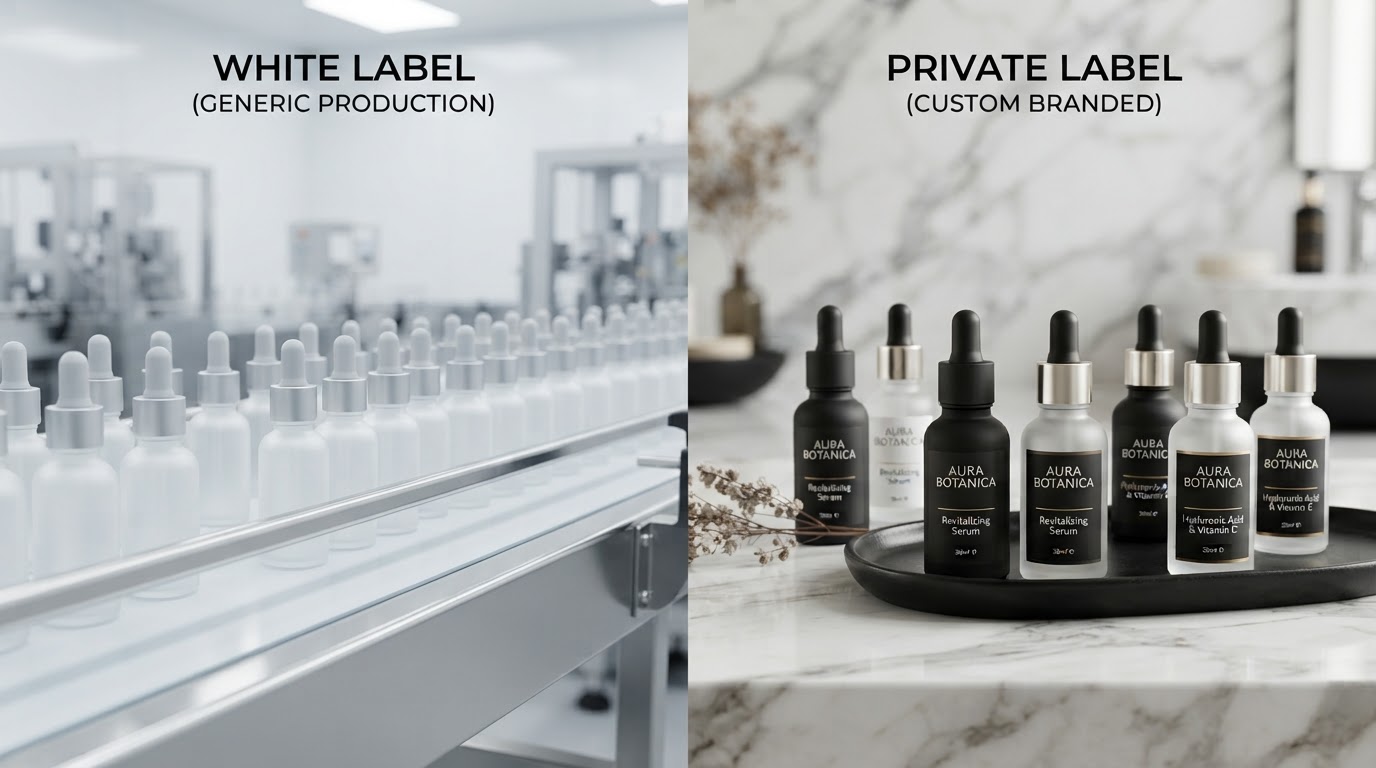
With white label skincare, a manufacturer produces a single, generic formula and sells that same formula — often with little to no customization — to many different brands. Each brand slaps its own logo on the bottle, but the product inside is identical across every seller. You get speed and low upfront cost, but you get almost no differentiation.
With private label skincare, you start from a manufacturer's portfolio of proven, pre-stabilized formulations, but you shape the final product: you choose which formulations make up your line, you select your packaging, you design your own waterproof labels and brand artwork, and you control how the collection is positioned. The base formula isn't bespoke to you, but the finished product — the thing your client unboxes — is unmistakably your brand.
That distinction matters because the product on the shelf is what your clients experience every morning and every night. If it looks like every other bottle in their cabinet, it stops being your brand and becomes a commodity.
Side-by-Side Comparison
| Factor | White Label | Private Label |
|---|---|---|
| Who else sells it | Many brands — same formula | Only you — your branding & packaging |
| Customization | Logo only, minimal changes | Packaging, labels, product mix, positioning |
| Brand equity | Low — easily copied | High — recognizable, defensible |
| Margins | Lower (commoditized) | Higher (premium positioning) |
| Time to market | Fastest | Fast (proven formulas, custom branding) |
| Upfront cost | Lowest | Low–moderate (MOQs per product) |
| Ability to differentiate | Very limited | Strong — your line, your identity |
What White Label Skincare Actually Looks Like
White label is the fastest path to putting a product on a shelf. A manufacturer already has a finished, stabilized formula sitting in inventory. You choose a SKU, add your label, and place an order. In some cases you can be selling within weeks. For a brand that needs to test demand quickly or fill a single gap in a larger retail lineup, that speed is attractive.
The trade-off is the one that matters most over time: you are not the only seller. When a client searches for the active ingredients in your serum, they may find three competitors selling the same formula under three different labels. Price becomes the only differentiator, and price competition is a race to the bottom. White label also offers almost no flexibility in packaging or label artwork — you're usually limited to what the manufacturer already stocks.
What Private Label Skincare Actually Looks Like
Private label starts from a portfolio of proven, pre-stabilized formulations — so you skip the 12-to-18-month custom development cycle and its associated costs — but everything the client sees is yours. You pick the cleansers, serums, moisturizers, and treatments that fit your audience. You choose the packaging, whether that's an airless pump, a frosted-glass dropper, or a matte-black tube. You design the waterproof labels and the brand artwork. The collection becomes a recognizable extension of your practice or brand.
The result is a line that is genuinely hard to copy. A patient who buys your practice-branded Vitamin C Serum and sees it on their bathroom shelf every morning is building a daily relationship with your brand — not a generic bottle they could reorder from anyone. That's what drives repeat purchases, reorders, and the higher margins that make a skincare line worth running.
Cost & Timeline: What to Really Expect
Both models are dramatically more affordable than building a custom formula from scratch, which can run $25,000–$100,000+ and take a year or more. Here's the realistic range for a first launch:
- White label: Lowest upfront cost, often a few hundred to a few thousand dollars per SKU depending on quantity. Fastest to market, but lowest differentiation and lowest long-term margins.
- Private label: Typically $1,500–$5,000 to launch a small curated collection of a few hero products, with flexible minimum order quantities (MOQs) per product. Lead times are commonly around four weeks for first orders once artwork is approved. You get proven formulas without the custom development risk, plus a brand you actually own.
- Custom formulation: The highest investment and longest timeline, reserved for brands that need a genuinely unique product. For a deeper comparison, read our guide on private label vs. custom formulation.
For the vast majority of med spas, dermatology and plastic surgery practices, aestheticians, and first-time skincare entrepreneurs, private label hits the sweet spot: low enough risk to get started, high enough differentiation to build a real brand.
Which Is Right for You? A Simple Decision Framework
Use these questions to decide between white label and private label for your skincare line:
Choose Private Label if…
- You want a brand clients recognize and can't get elsewhere.
- You're a practice (med spa, derm, plastic surgery, aesthetician) extending patient care home.
- You care about premium packaging, waterproof labels, and cohesive brand identity.
- You want higher margins and defensible brand equity over time.
- You're building a collection, not just one SKU.
White Label may be enough if…
- You only need to test demand for a single product fast.
- Brand differentiation isn't a priority for this channel.
- You're filling a gap in an existing retail lineup.
- You have no budget for packaging or label customization.
If you read those two columns and the first one describes you, private label is almost certainly the right path — and it's not as hard as it sounds. You don't need to be a chemist or have manufacturing experience; you need a manufacturing partner that understands aesthetic professionals and guides you from formulation selection through launch.
The Hidden Cost of "Easy" White Label
White label's appeal is that it's fast and cheap. Both are true. But the hidden cost is that you're building no moat. Every reorder is a commodity sale, and every competitor who finds the same manufacturer can undercut you overnight. Practices that start on white label almost always migrate to private label once they realize how much brand equity and margin they're leaving on the table. Starting on private label from day one means you build that equity from the first bottle.
Private label also gives you something white label can't: a collection. A cleanser, a targeted serum, and a barrier-supporting moisturizer under one cohesive brand identity creates a daily skincare ritual your clients follow — and reorders. Single white-label SKUs don't do that. For a practical starting point, read our guide on how to start a skincare line and build a standout brand.
Why Inspira Skin Specializes in Private Label
Inspira Skin is a U.S.-based private label skincare manufacturer built specifically for med spas, dermatology and plastic surgery practices, aestheticians, and skincare entrepreneurs. We offer 80+ professional-grade formulations across cleansers, toners, serums, moisturizers, eye treatments, masks, exfoliants, suncare, and targeted treatments — all pre-stabilized and ready to brand.
Every private label partnership includes real physical sampling, flexible packaging options (including airless pumps, frosted glass, and matte-black suites), true waterproof labels that survive humid bathrooms, custom label artwork support, and hands-on launch guidance. You own the brand and the client relationship; we own the manufacturing.
If you're ready to see what a private label line could look like for your practice or brand, the fastest next step is our two-minute skincare brand quiz — it recommends formulations and next steps based on your audience and goals — or you can book a consultation with our team.
The Bottom Line
White label and private label both get you to market faster than custom formulation — but only one builds a brand worth owning. White label trades differentiation for speed; private label keeps the speed and gives you a recognizable, defensible line your clients can't get anywhere else. For aesthetic professionals and skincare entrepreneurs building something that lasts, that difference is the whole game.